
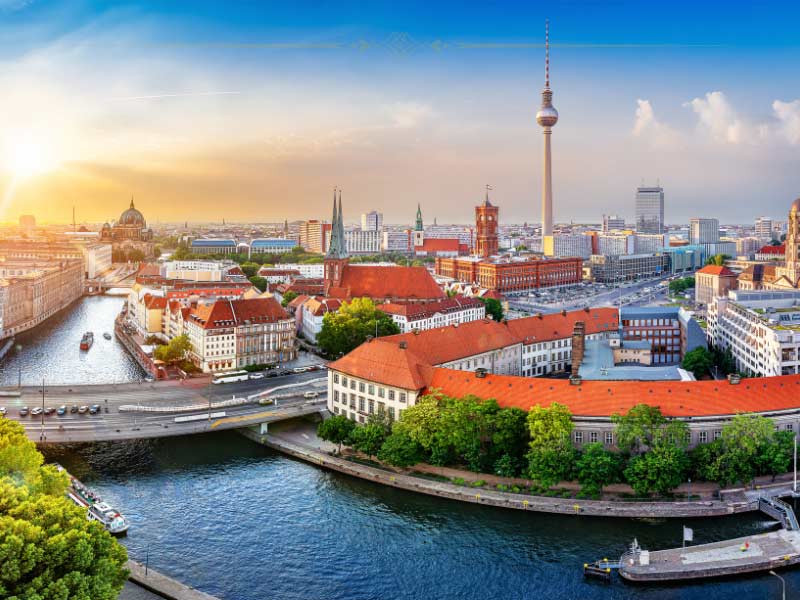
Germany’s capital Berlin is a city of contrasts – where historic meets modern, where the upmarket meets the alternative – it has an atmosphere that’s energetic and yet relaxed. We instantly fell for Berlin – it’s a very laid-back city that has so many things to see and do, you could easily spend several days exploring. Our one day in Berlin itinerary aims to cover the city’s main attractions that can be seen in a short time.
How to move around Berlin
Much of this itinerary is walkable but you will be putting in a fair number of steps. Although the time taken to walk between each location isn’t particularly lengthy, it may mean that you have less time at some of the attractions. You may also need to prioritise what you would like to see as the time spent at a particular location will vary depending on your interests. For example, the art or historical exhibitions on Museum Island may require a couple of hours there to enjoy them fully.
This itinerary requires an AB zone travel card, which would cover all your transportation for the day. It will get you to the starting point and also transport you around the city if you choose to travel using public transport. A 24 hour card is good value if you plan to use public transport three times or more during the day. You can buy a card at U-bahn or S-bahn stations via a machine. Don’t forget to validate the card when you start using it.
The Perfect One Day In Berlin Itinerary
Morning
We enjoyed a world class breakfast at the Mövenpick hotel on Schöneberger Str. 3. We can highly recommend their extensive buffet which had a large range of options, from continental to fully cooked. Particular highlights were the meats, cheeses and fresh fruit, as well as a wonderful range of seeded breads. This breakfast completely set us up for a great day’s sightseeing.
We start our tour in East Berlin. It is impossible to visit this region without acknowledging its history and particularly that of the Berlin Wall, which divided the city from 1961 to 1989.
Morning activities:

1. The East Side Gallery is the longest section of wall remaining and is adorned with murals painted by more than 100 artists from all around the world. Start at Warschauer Straße (U-Bahn, S-Bahn or Tram). The paintings along the gallery can be seen from the section of the wall at Oberbaum Bridge and continue for 1.3 kilometres to Ostbahnof.
At Ostbahnhof pick up the S-bahn and head towards Alexanderplatz.
2. The Fernsehturm TV Tower was constructed between 1965 and 1969. It is not only a functioning broadcast tower but, in its time, was also a symbol of Communist power. At 368m, it is the tallest structure in Germany and dominates the skyline in Berlin. You can visit the observation deck – shooting up in the elevator to 203m to view a 360 degree panoramic view of the city.

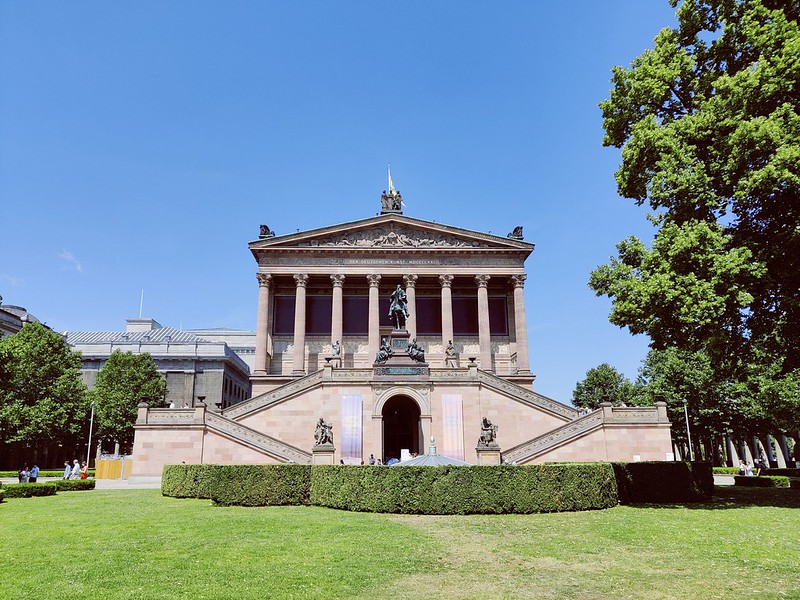
3. Either walk or take the U-bahn (U5) from Alexanderplatz to Museum Insel, a UNSECO world heritage site, where there are five famous museums to explore. If you decided to visit all of them you could easily spend the entire day on the island, but we suggest visiting just one. The choices are:
Altes Museum – the first museum on the island originally offered viewings of the royal art collection but primarily exhibits treasures from Greece and Rome.
Neues Museum – this is a museum of early history and contains classical antiquities from Egypt, including the famous bust of Nefertiti.
Alte Nationalgalerie – if paintings are of interest, this museum houses an art collection from classical through to romanticism to the early modern age. Several classical sculptures are also housed here. We were lucky to catch the Caspar David Friedrich retrospective – he is one of Germany’s best known landscape painters. His painting The Monk by the Sea is a permanent exhibit.
Bode Museum – the place to see sculptures as well as Byzantine art.
Pergamon Museum – one of the most popular museums, this houses a vast collection of Greek and Roman art, as well as Islamic art. The Roman Pergamon Altar is its most famous attraction. Unfortunately, Pergamon is currently closed for renovation and won’t be open again for several years, they will slowly be reopening galleries from 2027.
If you definitely plan to visit one of these museums, we recommend pre-booking a ticket, so that you can skip the queue if needed.
Even if you don’t visit any of the museums it is worth spending some time here to appreciate the grandeur of the architecture. Berlin Cathedral is also located on the island.
After leaving Museum Island head towards Berlin’s main street, Unter den Linden. This is a broad boulevard lined with all sorts of shops and restaurants. It will take around 35-45 minutes to walk along it reach the Brandenburg Gate, depending on how fast you walk and how many shops you might want to browse, so if you are short on time, we suggest taking the U5 to Brandenburger Tor.
Lunch

For lunch we recommend a delicious Berlin currywurst. There are many street stalls on Unter den Linden, which also offer seating. Currywurst is a sausage, conveniently sliced, and doused in mildly spiced curried ketchup. If you’re feeling decadent, you could order a few fries and maybe a beer as well.
Afternoon
The afternoon is spent in central Berlin. There are a number of choices depending on the activities that are most of interest. Again, you may wish to prioritise as there are some locations where you may want to linger.
Afternoon activities

1. Continue along Unter den Linden to arrive at the Brandenburg Gate. This is one of Berlin’s most recognisable landmarks, originally a gate that marked the route from Berlin to Brandenburg. A huge and imposing monument, it has featured prominently during many moments of German history.
Then turn right just beyond the Brandenburg Gate and follow the road around to visit the Parliament Building, the Reichstag. It is an impressive building with a glass dome. It is possible to visit the dome to see views across Berlin. Guided tours are also available. These are free but you will need to book a timed ticket online. We recommend booking at least a week or two in advance, even if you only wish to visit the dome, as tickets do sell out. The Reichstag and the Brandenburg Gate also mark the entrances to the Tiergarten, a lovely park.

We suggest returning to the Brandenburg Gate and then heading out towards Potsdamer Platz, a modern square. It’s around a ten-minute walk. You could catch the S-bahn (S1 or S2) from Brandenburger Tor, although it would be much easier to walk. We passed by the Holocaust Memorial, designed by architects Peter Eisenman and Buro Happold, a sobering monument which comprises thousands of grey stelae covering an undulating field.
2. If art is your thing, then Kulturforum, to the west of Potsdamer Platz, has a broad range of exhibitions. And the nearby Neue Nationalgalerie is a modern art museum which has a permanent collection, as well as some interesting temporary exhibitions. When we visited, they had Andy Warhol and Gerhard Richter retrospectives. We enjoyed the interactivity of many of the exhibits here.
3. If history is of interest, you can walk down Stresenmannstrasse, then turn left into Niederkirchnerstrasse and visit the Topography of Terror exhibition. It’s located alongside a section of the Berlin wall and is the former site of the SS Command. This isn’t an easy museum to visit but it gives a very honest history of National Socialism within Germany and serves as both a remembrance and a cautionary tale from the past.

Continue along Niederkirchnerstrasse until you reach Checkpoint Charlie, one of Berlin’s most famous landmarks. It served as one of the crossings between East and West Berlin during the Cold War. Be prepared for a queue if you want to have your picture taken there.

After briefly observing Checkpoint Charlie we crossed the road to visit The Wall – Asisi Panorama, an installation by artist Yadegar Asisi. Set inside a tall building it displays an exhibition showing the history of the Berlin Wall, but the main attraction is the huge mural that depicts life on both sides of the wall. The lighting changes from daytime to nighttime and is accompanied by an audio soundtrack. We climbed up onto the 4m platform and recommend spending time to view the full installation. We also watched the fascinating documentary about the artist which runs on a loop throughout the day. It showcases the impact that the wall had on his life growing up in East Germany.
Dinner at Paulaner Wirtshaus Berlin

We suggest a 10 minute walk back to Potsdamer Platz which has a large number of restaurants that will cater for any taste. If you would like to try German fare, Paulaner Wirtshaus Berlin offers hearty food as well as a number of beers.
You can choose from a range of German dishes from snacks to full dinners. (NB this is a Bavarian restaurant.) We recommend the Bavarian Trio which is a taster platter comprising succulent pork knuckle with crispy crackling, sausages and schnitzel accompanied by potatoes, salad and sauerkraut. Don’t forget to order a stein of beer!
Alternatively, nearby Manifesto Markt is a food court that houses a large number of street food stalls from all over the world. There is plenty of seating and a bar. There will almost certainly be something to suit everyone. Note that this is closed on Sundays.
Night
Berlin is famous for its nightlife and there are a large number of options if you still have the energy for dancing after all the sightseeing. Sisyphos, Berghain and Anomalie are amongst the most famous clubs in the city.
It’s worth knowing that some clubs have a door policy. And all will either ask you to lock away your phone or they will place a sticker over the camera so that everyone can enjoy privacy whilst enjoying the night.
The city also has a huge number of bars for more sedate drinking, sometimes with a Berlin twist. We enjoyed some fabulous cocktails at the Newton Bar, with photographer Helmut Newton’s distinctive but most definitely, er, adult décor. And, of course, there are lots of bars where you can enjoy beers, particularly Berliner Weisse, a refreshing wheat ale that is a specialty of the region.
Spending the night?
We stayed at the Mövenpick hotel on Schöneberger Str. 3, around a 15-20 minute walk from Potsdamer Platz. It is a grand construction that has been converted from a former Siemens building. We can highly recommend this hotel, with its large rooms and excellent facilities. Breakfast is available until 10am every day – useful if you have been clubbing the night away. Unless, of course, you’re still enjoying the party! Click here to see the latest rates.
Author’s Box: Mitch and Colin live in the English Midlands and have been travelling the world for more than 30 years. They have visited over 50 countries together. Their travel blog for foodies, Very Tasty World, features articles about their journeys, itineraries, and introductions to countries’ cuisines. They also share recipes for many of the delicious dishes they have tasted on their travels. When they are not travelling, they’re planning the next trip or experimenting with exotic ingredients in the kitchen.
Like It? Pin it!